
frozen chicken, Frozen Poultry
The Global Frozen Chicken Market: Trends & Suppliers
Oct
The Global Frozen Chicken Market: Trade Trends, Wholesale Prices, Exporters & Buying Guide


The global frozen chicken market plays an essential role in international food trade, connecting poultry producers, meat processors, wholesalers, importers, supermarkets, and foodservice businesses.
From Brazilian frozen chicken exporters to poultry distributors supplying Africa, the Middle East, Asia, and Europe, frozen chicken is an important source of animal protein for millions of consumers.
For international buyers, however, finding a reliable frozen chicken supplier involves more than comparing prices. Product quality, Halal certification, cold-chain management, export documentation, and shipping conditions all influence the success of a transaction.
At BEYPLIC, our focus is helping prospective buyers explore frozen chicken and meat sourcing opportunities.
This guide examines global frozen chicken market trends, major exporting countries, wholesale purchasing considerations, product specifications, packaging requirements, and opportunities for businesses importing frozen poultry and beef.
Global Frozen Chicken Market Overview in 2026
The international poultry industry continues to evolve as demand, production efficiency, food safety requirements, and trade policies influence global supply.
According to the OECD-FAO Agricultural Outlook 2026–2035, poultry remains an important contributor to projected growth in meat consumption. The outlook also identifies changing trade patterns, production efficiency, animal disease, and trade restrictions as important market factors.
Frozen chicken is particularly relevant to businesses that need predictable storage conditions, longer distribution windows, and access to internationally traded poultry products.
What Is Driving Frozen Chicken Demand?
Several factors support demand for frozen chicken:
-
Consumer affordability: Chicken is often competitively priced relative to other animal proteins.
-
Foodservice expansion: Restaurants, hotels, caterers, and institutional kitchens purchase poultry in commercial quantities.
-
International distribution: Freezing supports long-distance transport when the cold chain is maintained.
-
Product versatility: Buyers can source whole chickens, wings, breast fillets, thighs, drumsticks, and other cuts.
-
Convenience: Frozen products support inventory planning and reduce the pressure to sell immediately after processing.
However, demand differs by country, product cut, consumer preferences, and local import regulations.
Major Frozen Chicken Exporting Countries


The global frozen chicken trade includes established poultry exporters and emerging suppliers.
Brazil – Major Frozen Chicken Exporter
Brazil is one of the world’s leading chicken meat exporters, supported by substantial poultry production and export-oriented processing operations.
The USDA’s April 2026 world meat trade report forecast Brazil’s chicken meat exports at approximately 5.1 million metric tons in 2026, maintaining its position among the largest international suppliers.
Brazilian frozen chicken is commonly purchased by international importers looking for products such as:
-
Frozen whole chicken
-
Frozen chicken breast
-
Frozen chicken wings
-
Frozen chicken drumsticks
-
Frozen chicken thighs
-
Frozen chicken paws and feet
Commercial buyers should confirm that the selected Brazilian processing establishment is approved for the destination market.
United States – Large Poultry Producer and Exporter
The United States has a substantial poultry industry and exports chicken products to international markets.
Product availability depends on domestic demand, processing requirements, importing-country regulations, and trade conditions.
European Union – Regional and International Supply
EU poultry businesses participate in regional distribution and international trade.
Buyers sourcing from European suppliers often consider traceability, food safety documentation, transport distances, and regulatory compliance.
Thailand and China – Growing Competitive Roles
Thailand is recognized for poultry processing and exports, including value-added chicken products.
China is also becoming more significant in international poultry trade. USDA’s October 2026 reporting highlights changes in global production and trade, while its earlier 2026 forecast identified substantial growth in Chinese chicken meat exports.
The right sourcing country depends on product type, approved export establishments, destination requirements, and actual delivered cost.
Global Frozen Chicken Market Trends for 2026 and Beyond
1. Increasing Importance of Food Safety
Food safety and traceability are central considerations in international poultry trade.
Importers increasingly need reliable documentation covering production facilities, veterinary inspection, shipment identification, and product handling.
2. Growing Demand for Halal Frozen Chicken
Halal-certified frozen chicken is an important purchasing category in markets where religious certification is required or commercially preferred.
Buyers should request a valid certificate issued by an acceptable certification organization and verify that the certificate covers the actual processing establishment and products.
Halal status should never be assumed solely from the country of origin.
3. Greater Attention to Cold-Chain Logistics
Frozen poultry quality depends on maintaining appropriate temperatures during processing, storage, loading, transport, and delivery.
Cold-chain interruptions can lead to thawing, quality deterioration, and potential food safety concerns.
4. Changing Global Trade Patterns
Disease outbreaks, government restrictions, tariffs, and changes in domestic production can redirect poultry trade.
The OECD-FAO outlook identifies animal disease and trade measures as significant uncertainties for global meat markets.
5. Growth in Value-Added Products
Commercial demand also extends to portion-controlled chicken cuts, boneless products, and prepared poultry.
These products can help foodservice operators standardize portions and manage preparation costs.
Wholesale Frozen Chicken Prices: What Determines the Cost?
Frozen chicken wholesale prices vary according to the product, origin, shipping terms, and market conditions.
The price of frozen chicken breast may differ significantly from whole chicken, wings, drumsticks, or paws.
Important pricing factors include:
-
Product cut and grade
-
Bone-in or boneless specification
-
Processing establishment and country of origin
-
Packaging weight and carton configuration
-
Order quantity
-
Freight and refrigerated transport costs
-
Currency fluctuations
-
Import duties and regulatory requirements
FOB vs. CIF Frozen Chicken Prices
FOB (Free on Board) means the seller delivers goods on board the vessel at the agreed port of shipment.
CIF (Cost, Insurance and Freight) means the seller arranges and pays for the agreed freight and required minimum insurance coverage to the destination port, although risk transfers when the goods are on board at the loading port.
Buyers comparing FOB and CIF frozen chicken quotations should request a clear breakdown of product specifications, shipping arrangements, and contractual responsibilities.
No single wholesale price accurately represents all frozen chicken products or destinations.
H2: Technical Details
Frozen chicken products intended for international trade must satisfy applicable food safety, veterinary, and importing-country requirements.
Product specifications should be confirmed through manufacturer documentation, inspection reports, and agreed commercial contracts.
Frozen Chicken Product Specifications Table
The following table is a sample purchasing specification, not a verified BEYPLIC product certificate.
| Parameter | General specification |
|---|---|
| Product | Frozen chicken meat |
| Species | Domestic chicken (Gallus gallus domesticus) |
| Product forms | Whole chicken and selected cuts |
| Processing | Slaughtered, processed and frozen |
| Appearance | Normal color for the specified cut |
| Odor | Free from objectionable odors |
| Storage temperature | Typically −18°C or colder |
| Freezing method | Blast frozen or IQF, depending on product |
| Bone content | Bone-in or boneless |
| Skin | Skin-on or skinless |
| Added water | Declare according to product and regulations |
| Net weight | As agreed per carton |
| Country of origin | According to shipment documentation |
| Halal certification | When required and verified |
| Shelf life | Manufacturer-validated period |
| Intended use | Human consumption |
| Traceability | Lot and establishment identification |
The USDA advises maintaining frozen foods at approximately −18°C (0°F) or colder for long-term freezer storage. Freezing inhibits microbial growth but does not reliably eliminate all microorganisms.
Common Frozen Chicken Products

Frozen Chicken Breast
Boneless or bone-in cuts for retail and foodservice

Frozen Chicken Wings
Whole wings or separated wing portions

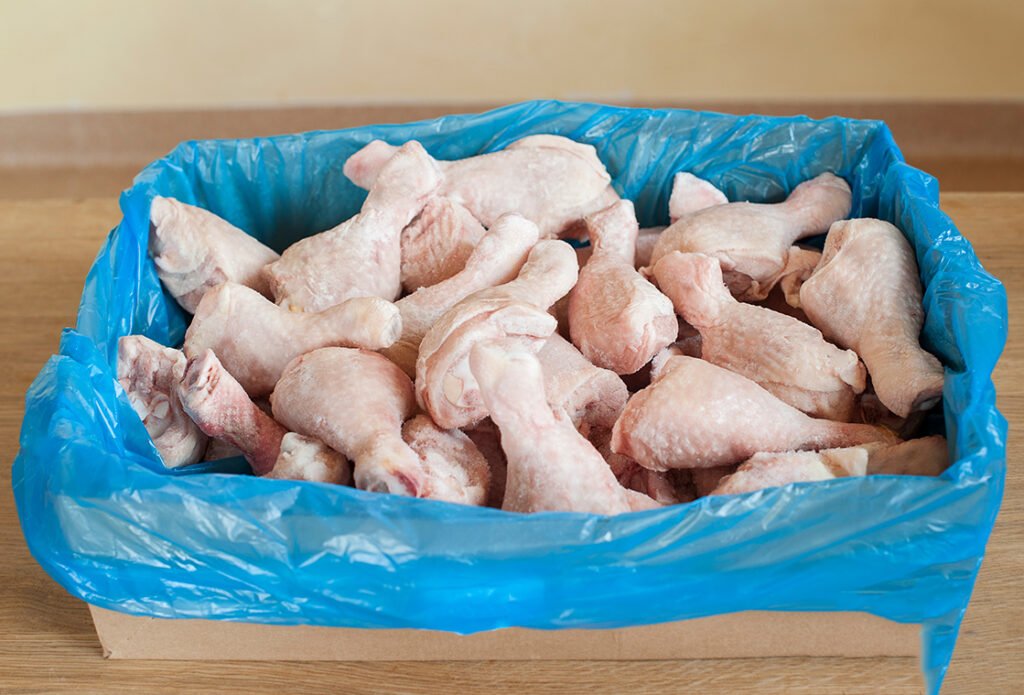
Frozen Chicken Drumsticks
Portion-controlled products for wholesale buyers

Frozen Whole Chicken
Whole birds supplied by agreed weight category
H3: Packaging Information
Packaging protects frozen chicken during storage, handling, and international transportation.
Commercial frozen chicken products are commonly packed in food-grade bags or liners and corrugated export cartons.
Frozen Chicken Packaging Specifications
| Packaging option | Typical application |
|---|---|
| 10 kg cartons | Wholesale poultry distribution |
| 15 kg cartons | Foodservice and import programs |
| 20 kg cartons | Bulk meat distribution |
| IQF bags | Individually frozen chicken cuts |
| Bulk export cartons | Full-container commercial shipments |
| Custom packaging | Subject to supplier capability |
Packaging weights are illustrative; actual net weight, carton dimensions, and labeling must be confirmed.
Frozen Chicken Container Loading
A refrigerated container’s usable payload depends on container specifications, carton dimensions, airflow requirements, loading configuration, and applicable weight restrictions.
Importers should request a written loading plan before agreeing to container quantities.
How to Choose a Reliable Frozen Chicken Supplier
Finding a trustworthy supplier is one of the most important steps in international meat procurement.
A professional purchasing process should include verification of the supplier’s legal identity, processing establishment, export eligibility, and product documentation.
Before placing a wholesale order, request the supplier’s registration details, applicable veterinary certificates, product specifications, packaging information, and shipment terms.
Where appropriate, use independent inspection and secure payment arrangements.
A low advertised price should not outweigh missing documentation or uncertainty about product origin.
Frozen Chicken and Beef Wholesale Opportunities


Many international food distributors purchase both frozen chicken and beef to serve supermarkets, restaurants, hotels, and institutional customers.
Businesses sourcing poultry may also explore related meat categories such as:
-
Frozen boneless beef
-
Halal beef
-
Frozen beef tenderloin
-
Beef ribeye
-
Frozen beef cuts for foodservice
However, chicken and beef have different product specifications, veterinary requirements, trade conditions, and pricing structures.
Buyers should request separate commercial offers for each category.
Why Explore Frozen Chicken Sourcing Through BEYPLIC?
At BEYPLIC, prospective wholesale buyers can explore frozen chicken and beef product information and prepare commercial sourcing inquiries.
A complete inquiry should include the requested chicken cut, quantity, destination country, destination port, packaging requirements, certification needs, and preferred delivery terms.
For example, a distributor may request a full refrigerated container of frozen chicken wings packed in 10 kg cartons, delivered CIF to a named port.
Providing detailed requirements helps establish whether a supplier can meet the requested specifications and issue a meaningful quotation.
Frequently Asked Questions
Which country exports the most chicken meat?
Brazil is among the leading global chicken meat exporters and was forecast by USDA to remain the largest in 2026.
What is the minimum order quantity for frozen chicken?
MOQ varies by supplier, product, packaging, and destination. Full refrigerated container loads are common in international wholesale trade.
What temperature should frozen chicken be stored at?
A typical frozen storage target is −18°C or colder, subject to applicable regulations and product specifications.
Can I import Halal frozen chicken from Brazil?
Potentially, provided the selected producer is approved for the destination market and the required Halal and veterinary documentation is valid.
Can frozen chicken and beef be purchased together?
Buyers may source both product categories, but availability, certification, shipment compatibility, and commercial terms must be verified separately.
Conclusion: The Future of the Global Frozen Chicken Market
The global frozen chicken market remains an important part of international food supply, supported by demand from households, restaurants, wholesalers, and food manufacturers.
For buyers, successful sourcing requires more than finding the lowest price. Verified suppliers, food safety, suitable packaging, cold-chain reliability, and clear export documentation are essential.
As trade patterns continue to change, importers that prioritize quality assurance and reliable commercial relationships will be better positioned to manage procurement risks.
Explore BEYPLIC for frozen chicken and beef product information and submit your wholesale purchasing requirements.
Request a frozen chicken quotation: Include your preferred cuts, quantity, packaging, destination port, and delivery terms.
